
Popular bingo formats
| Format | Ticket layout | Typical feel |
|---|---|---|
| 75-Ball | 5x5 with a free centre space | North American pattern play |
| 90-Ball | 9x3 | Three prize tiers: one line, two lines, full house |
| 30-Ball | 3x3 | Fast speed-bingo rounds |
| 80-Ball | 4x4 | Colour-coded quadrants and pattern prizes |
How Online Bingo Works
Online bingo follows the same core concept as its traditional counterpart: players purchase one or more tickets (or "cards") containing a grid of numbers, and a caller - automated in nearly all online formats - randomly draws numbers one at a time. As numbers are called, matching numbers on your ticket are automatically marked (most online platforms handle this automatically, removing the need to manually daub each number), and the first player to complete the required pattern wins the round's prize.
Unlike slots or table games, bingo's outcome for any individual player depends partly on the numbers drawn and partly on how many other tickets are in play during that round - more participants generally means more competition for the same prize pool, though prize pools themselves often scale up with participation too.

Types of Bingo Games
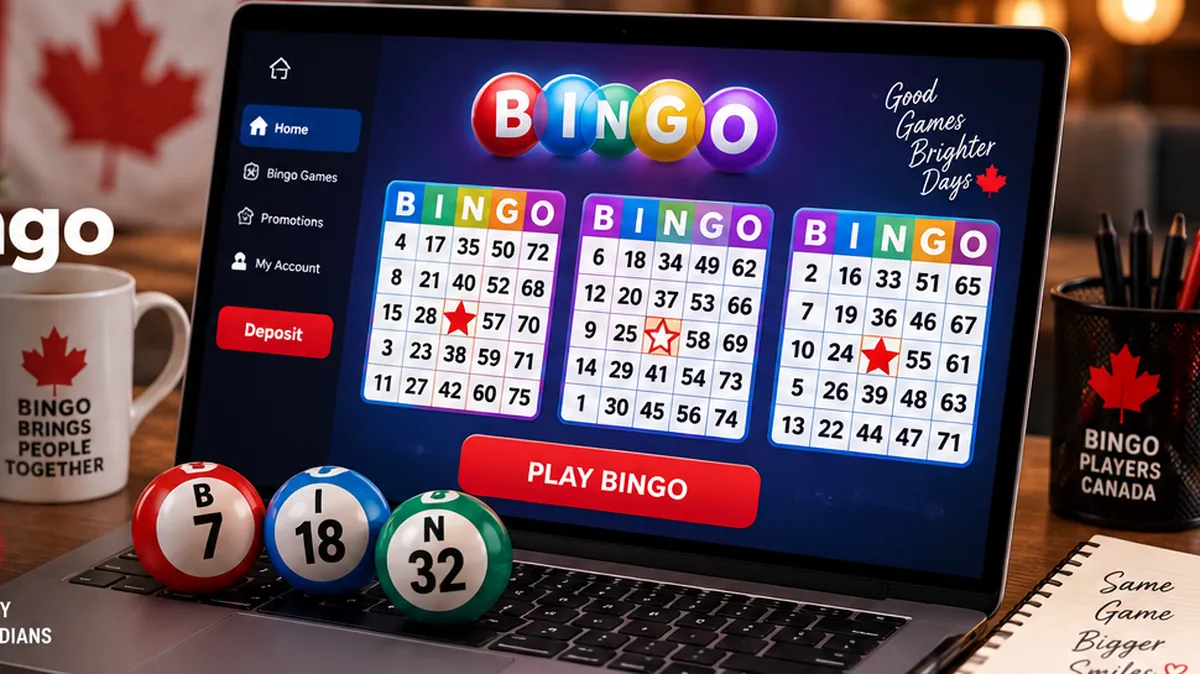
75-Ball Bingo is the format most familiar to North American and Canadian players, using a 5x5 grid with a free center space, and typically played toward specific patterns (lines, shapes, or a full house/blackout) rather than simply completing any single line.
90-Ball Bingo is more common in UK-style online rooms but widely available to Canadian players as well, using a 9x3 grid per ticket with three separate prize tiers within a single game - one line, two lines, and a full house - giving players multiple chances to win within the same round.
30-Ball Bingo (Speed Bingo) uses a smaller, faster 3x3 grid, with rounds typically completing in just a couple of minutes. It's a good fit for players who want quick, low-commitment sessions rather than the longer pacing of 75-ball or 90-ball games.
80-Ball Bingo sits between the other formats, using a 4x4 grid divided into four color-coded quadrants, with prizes often awarded for completing patterns within specific quadrants as well as the full card.

Bingo Patterns and Prizes
Beyond simply completing a full card, most bingo rooms offer prizes for specific patterns formed as numbers are called - a straight line, four corners, an "X" shape, or various themed patterns tied to a room's specific promotional event. Pattern-based prizes typically pay out faster and more frequently than full-card (or "blackout"/"coverall") prizes, which usually offer the largest single payout of a given round but take longer, on average, to complete.
Progressive jackpots are common in online bingo as well, often tied to completing a full card within a specific, limited number of calls - the fewer calls required, the larger the jackpot, creating genuine excitement as a room collectively tracks how close the current game is to a jackpot-qualifying finish.
Bingo Room Types and Community Features
One of online bingo's most distinctive features compared to other casino games is its social component. Most online bingo rooms include live chat functionality, allowing players to interact with each other and, often, a dedicated chat host who runs additional mini-games, giveaways, and community events alongside the main bingo draws. This social layer is a genuine part of the appeal for many regular bingo players, offering a sense of community that's largely absent from solo-focused games like slots.
Themed rooms built around specific holidays, seasons, or promotional events are common, often featuring special jackpots, unique patterns, or bonus prizes tied to the theme.
Variable-priced rooms let players choose ticket price points that match their budget, from penny rooms designed for casual, low-stakes play to higher-priced rooms with correspondingly larger prize pools.
Scheduled vs. continuous rooms. Some rooms run on a fixed schedule with games starting at specific times, while others run continuously, starting a new game as soon as the previous one concludes - worth checking if you're planning a session around a specific time window.
How Bingo Odds Actually Work
Bingo's odds are fundamentally different from most other casino games because your chances of winning depend directly on how many tickets are in play during a given round, not on a fixed house edge calculated against your individual wager the way slots or roulette work. Buying more tickets for a single round increases your chances of winning that round, but also proportionally increases your total spend - it doesn't change your underlying odds per dollar wagered in most cases.
Some practical implications worth understanding:
- Smaller, less popular rooms can offer better effective odds simply because fewer total tickets are competing for the same prize pool, even if the prize pool itself is smaller.
- Buying multiple tickets for a single game increases both your chances and your cost proportionally - it's a way to manage variance and increase your win frequency, not a way to improve your underlying value per dollar spent.
- Speed formats (like 30-ball) complete more rounds per hour, which means more opportunities to win smaller prizes, compared to the fewer, potentially larger-prize rounds typical of full 75-ball or 90-ball games.
Bingo vs. Other Casino Games: What Makes It Different
Bingo occupies a genuinely distinct niche compared to the rest of the casino game library. Unlike slots, where each spin is an independent, instant outcome, bingo rounds unfold over several minutes with a growing sense of anticipation as numbers are called and players get closer to completing their pattern. Unlike blackjack or poker, there's no strategic decision-making involved once you've purchased your ticket - the numbers called and your ticket's fixed number grid entirely determine the outcome, making bingo purely a game of chance with a social wrapper around it.
This combination - no skill requirement, a social community layer, and a slower, more relaxed pace than most other casino games - is exactly why bingo tends to attract a distinct player base, often skewing toward players looking for lower-pressure entertainment rather than the faster, higher-intensity experience of slots or live dealer table games.
Tips for Getting More Out of a Bingo Session
Set a budget for the session, not per individual ticket. Because bingo involves buying multiple tickets across multiple rounds, it's easy to lose track of cumulative spend if you're only thinking about the cost of each individual round in isolation.
Try lower-traffic rooms if your goal is maximizing win frequency over prize size. Smaller rooms with fewer competing tickets offer better relative odds of winning individual rounds, even if the total prize pool is more modest.
Take advantage of the chat and community features if that's part of the appeal for you. Many bingo rooms run additional chat games, giveaways, and community events that add value beyond the core bingo draws themselves - genuinely worth exploring if the social aspect is part of why you're drawn to bingo in the first place.
Understand that speed formats and full-length formats offer different experiences, not just different odds. If you're looking for quick, frequent action, 30-ball speed rooms fit that goal; if you prefer a slower-building, more suspenseful session, traditional 75-ball or 90-ball rooms are likely a better fit.
Check for bingo-specific promotions separately from general casino welcome bonuses. Many operators run bingo-specific deposit bonuses, free ticket promotions, or loyalty programs distinct from their broader casino bonus structure - worth checking directly on a bingo room's promotions page rather than assuming a general casino bonus automatically applies.
Bingo and Casino Bonuses
Bingo-specific promotions are common at operators that run dedicated bingo rooms, often including free tickets for new players, deposit-matched bonus tickets, or loyalty points that can be redeemed for additional plays. As with any bonus, it's worth checking the specific terms - including any wagering requirements attached to bingo bonus winnings - before assuming a promotion is straightforwardly valuable. Our Payment Methods and Bonus Guide covers how to evaluate bonus terms across game types, including the game-contribution nuances that can apply differently to bingo than to slots or table games.
Mobile Bingo
Bingo translates particularly well to mobile play, since its slower pace and automatic number-marking make it easy to follow along on a smaller screen without needing the precise timing or careful attention that faster games like live dealer blackjack can require. Many players treat mobile bingo as a background activity they can dip in and out of during a game, rather than requiring the same dedicated, focused attention slots or table games typically demand - a genuine part of its appeal for players fitting sessions around a busy schedule.
A Brief History of Bingo
Bingo's roots trace back to a 16th-century Italian lottery game, which spread through Europe over the following centuries - most notably as a French game called "Le Lotto" played among the French aristocracy in the 1770s, and later as a numbers-matching game used in German schools to teach children spelling and arithmetic. The game arrived in North America in the early 20th century, where an American toy salesman is widely credited with popularizing the modern version and coining the name "Bingo," after reportedly overhearing an excited winner call it out instead of the traditional "beano" in the late 1920s. From there, bingo spread rapidly through church halls, community centers, and dedicated bingo parlours across North America, becoming a fixture of Canadian community life for much of the 20th century before making the natural transition online alongside the broader shift toward internet-based gambling in the late 1990s and 2000s.
Online bingo preserved much of what made the traditional version popular - the social atmosphere, the anticipation of watching numbers called, the accessibility for players of any experience level - while adding conveniences like automatic number marking, a far wider range of ticket price points, and the ability to join a room from anywhere rather than needing to travel to a specific physical hall on a specific schedule.
Bingo Terminology Glossary
the person (automated in nearly all online formats) who announces each drawn number.
traditionally, the ink marker used to mark called numbers on a physical paper ticket; used more loosely online to refer to the automatic marking of numbers on a digital ticket.
completing an entire bingo ticket, typically the largest prize tier in a given game.
a bingo variant where players win by completing a specific shape or pattern on their ticket (like an X or four corners) rather than a full house.
a pre-marked space, most common in the center of 75-ball bingo tickets, that counts as automatically matched for pattern purposes.
a progressive jackpot tied to completing a full card within a specific, limited number of calls, with the jackpot size often scaling based on how few calls are required.
a fast-paced bingo variant, often using smaller grids like 30-ball formats, designed to complete rounds in just a couple of minutes.
a staff member who moderates a bingo room's live chat and typically runs additional mini-games, giveaways, and community events alongside the main bingo draws.
Why Bingo Remains Popular in Canada
Bingo has held a distinctive place in Canadian community life for decades, historically associated with church halls, legion branches, and community centers hosting regular in-person games as both entertainment and a fundraising tool for local causes. That community and charitable association has carried over, in a modified form, into the online space - some online bingo platforms maintain ties to charitable fundraising models, though this varies significantly by operator and province, and is worth researching directly if it's a specific factor in your choice of where to play.
The game's continued popularity in its online form largely comes down to accessibility: no specialized skill or strategy is required, sessions can be as short or long as you like, and the social chat component recreates a meaningful part of what made in-person bingo halls appealing in the first place, all without requiring a trip to a physical venue.
Bingo for Charitable and Fundraising Purposes
Beyond standard commercial online bingo rooms, some Canadian platforms maintain a connection to charitable fundraising models, reflecting bingo's long history as a fundraising tool for community organizations, legions, and religious institutions across Canada. Where this connection exists, a portion of proceeds may be directed toward a specific cause or organization - worth researching directly on a given platform if supporting a charitable model is specifically important to you, since this varies considerably by operator and isn't a universal feature of online bingo.
Setting a Bingo Schedule That Works for You
Because many bingo rooms run on a fixed schedule rather than continuously, building a bit of routine around specific game times can genuinely enhance the experience, particularly for players drawn to the social, community aspect of the game. Regular players at a specific scheduled room often develop familiarity with the same chat host and recurring players over time, recreating some of the community feel of a traditional in-person bingo hall. If your schedule doesn't align well with fixed-time rooms, continuous rooms that start a new game as soon as the previous one fills remain a flexible alternative that doesn't require planning around a specific start time.
Bingo Variants Around the World
While 75-ball and 90-ball formats dominate the Canadian and broader North American and UK-influenced markets, bingo takes different forms internationally - from 80-ball formats popular in some European markets to regionally specific variants with unique pattern rules and prize structures. Most major Canadian-facing online bingo platforms focus on the 75-ball, 90-ball, and speed (30-ball) formats covered in this guide, since these represent the formats with the deepest player pools and most established software support, though exploring platforms with a broader international format selection can be worthwhile for players specifically interested in trying something less common.
Choosing Between Multiple Bingo Rooms
Most Canadian-facing platforms with dedicated bingo sections run several rooms simultaneously, differentiated by ticket price, format (75-ball, 90-ball, speed), and sometimes theme. Rather than settling into a single default room, it's worth periodically checking room occupancy and prize pool size before buying in - a room showing unusually low ticket sales for an upcoming game can represent better relative odds, while a room with a large accumulated progressive jackpot nearing its qualifying call threshold can be worth prioritizing if chasing that specific jackpot is part of your goal for the session. Platforms typically display this information directly in the room lobby, making it easy to compare options before committing to a specific ticket purchase.
Progressive Jackpot Bingo: A Closer Look
Progressive bingo jackpots deserve particular attention because their odds work differently from a standard bingo prize. A jackpot tied to completing a full card within, say, 40 calls or fewer only pays out at the full jackpot amount if a player achieves that specific threshold - a rare outcome that depends heavily on the specific numbers drawn during that round. Many rooms offer a smaller, guaranteed consolation prize for a full card completed just outside the jackpot threshold, softening the all-or-nothing nature of the jackpot chase. Understanding a specific room's jackpot rules - the exact call threshold, how the jackpot grows, and what the consolation prize structure looks like - before playing is worth doing if a specific jackpot is your main reason for choosing a room, since these rules vary meaningfully between operators and even between different rooms on the same platform.
Frequently Asked Questions
Bingo is purely a game of chance once you've purchased your ticket - there's no skill-based decision-making during the game itself, unlike blackjack or poker. The main "strategic" choices are which room to play in, how many tickets to buy, and how to manage your session budget.
Buying more tickets for a single round increases your chances of winning that specific round, since you have more chances to match the called numbers, but it doesn't change your underlying value per dollar spent - more tickets means proportionally more cost as well as proportionally more chances.
75-ball bingo uses a 5x5 grid with a free center space and is more common in North America; 90-ball bingo uses a 9x3 grid with three separate prize tiers (one line, two lines, full house) within a single game and is more common in UK-style rooms, though both are widely available to Canadian players.
Yes, at licensed operators - progressive bingo jackpots, often tied to completing a full card within a limited number of calls, are genuinely paid out when won, subject to the same licensing and auditing standards as other casino games.
Yes, most online bingo rooms include live chat functionality, and many run additional chat-based games and community events hosted by a dedicated chat moderator alongside the core bingo draws.
Ready to Play?
Bingo offers a genuinely different kind of casino experience - social, low-pressure, and easy to pick up regardless of prior gambling experience. Compare licensed Canadian bingo rooms on our homepage, confirm what's available in your province, and explore our Online Slots Guide if you're looking for another relaxed, no-strategy-required game to try alongside bingo.
This guide is for informational purposes only. Gambling involves financial risk; play only with money you can afford to lose. If gambling is affecting you or someone you know, visit our Responsible Gambling page.
Keep the game in perspective
Set your budget before you play, use the player-protection tools offered by licensed operators, and treat gambling as entertainment rather than a financial strategy.
Responsible Gambling Guide →